Activity 1.16: Counting Loops

Activity 1.16
Counting Loops
Key Concepts
A Loop That Counts For You
Using the Counter
Drawing N Things
What You Are Building
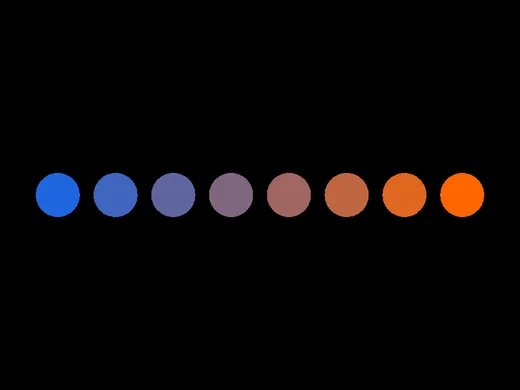
Eight circles from one circle command.
Last Session, the Long Way
local count = 1
while count <= 8 do    print(count)    count = count + 1end
Last Session, the Long Way
local count = 1
while count <= 8 do    print(count)    count = count + 1end
Start it, check it, change it. Three lines of bookkeeping for one line of work.
Today, the Short Way
for i = 1, 8 do print(i)endToday, the Short Way
for i = 1, 8 do print(i)end12345678All three parts are on the first line. You cannot forget the one that changes.
Reading the First Line
for i = 1, 8 do- i
- A variable the loop makes for you. You pick the name.
- 1
- What it starts at.
- 8
- What it counts up to, and including.
Eight passes, and i is 8 on the last one. Not 7.
A Third Number Changes the Step
for i = 1, 10, 3 do print(i)endA Third Number Changes the Step
for i = 1, 10, 3 do print(i)end14710It stopped at 10 because 13 would be past the end.
And a Negative Step Goes Backwards
for i = 5, 1, -1 do print(i)endAnd a Negative Step Goes Backwards
for i = 5, 1, -1 do print(i)end54321Which is last session's countdown, in one line.
The Counter Is the Useful Part
i is not just bookkeeping. It is a different number on every pass, and you can put it anywhere a number goes.
Which is how one circle line draws eight circles in eight places.
i Only Exists Inside
for i = 1, 3 do    print("inside " .. i)end
print("after: " .. tostring(i))
i Only Exists Inside
for i = 1, 3 do    print("inside " .. i)end
print("after: " .. tostring(i))inside 1inside 2inside 3after: nilThe loop made it, used it, and threw it away. Outside, it is nil.
Today's Objectives
- Write a counting loop
- Use the counter inside the loop
- Change the start, the end, and the step
- Draw N shapes from one drawing command
Key Terms
- for
- A loop that counts, with all three parts on one line.
- Loop counter
- The variable the loop makes and changes for you.
- Step
- How much the counter changes each pass. One unless you say otherwise.
- Scope
- Where a name exists. The counter exists only inside its loop.
'F' → Fullscreen
Build
Task 1: Count in the Terminal
Copy template-console to 1-16-count. Predict the output of each of these before running it, and write both your prediction and the result:
for i = 1, 5 do print(i)end
for i = 3, 7 do print(i)end
for i = 1, 10, 2 do print(i)end
for i = 10, 1, -2 do print(i)endThe third and fourth are the ones people get wrong. Count how many lines each produces before you run it.
Task 2: Use the Counter
Add these two, and work out what they do first:
for i = 1, 10 do print(i .. " times 7 is " .. i * 7)end
for i = 1, 5 do print(i .. " squared is " .. i * i)endA times table in three lines. Change the 7 and you have a different one.
Task 3: Eight Circles, One Command
Copy template-game to 1-16-row:
local count = 8local gap = 800 / (count + 1)
function love.draw() for i = 1, count do love.graphics.circle("fill", i * gap, 300, 34) endendRun it, then change count to 3, then to 20. The circles space themselves out, because gap is worked out from count rather than typed in.
count + 1? With 8 circles there are 9 gaps — one before the first and one after the last. Try 800 / count instead and see where the last circle ends up.Task 4: Make the Counter Visible
Use i for the color as well as the position:
for i = 1, count do love.graphics.setColor(i / count, 0.4, 1 - i / count) love.graphics.circle("fill", i * gap, 300, 34)endEvery circle is drawn by the same line of code, and no two look the same. Write down what i / count is on the first pass and on the last.
Task 5: Your Own Pattern
Change the row into something of your own. Pick at least two:
- Make the circles grow as they go across, using
ifor the radius - Make them into a diagonal line instead of a row
- Draw squares, and rotate the colors the other way
- Use a negative step so the loop draws right to left, and explain why the picture is identical
Challenge (Optional): Break It on Purpose
Move the drawing line outside the loop:
for i = 1, count doend
love.graphics.circle("fill", i * gap, 300, 34)
The window turns blue. Copy the message, then explain it using what the slides said about where i exists.
Challenge (Optional): A Circle of Circles
Arrange the circles in a ring instead of a row. You need math.cos and math.sin, and the angle for circle i out of count is i / count * 2 * math.pi.
This is a real use of trigonometry and you are not expected to derive it. Multiply the cosine by a radius, add 400, and see what happens.
Same Idea, Exam Notation
The exam has a counting loop, and it does not give you a counter. This is the widest gap between Lua and the exam sheet in the whole quarter.
for i = 1, 8 do print(i)endi ← 1
REPEAT 8 TIMES{ DISPLAY(i) i ← i + 1}REPEAT n TIMES has no variable in it
REPEAT 8 TIMES runs a block eight times and tells you nothing about which pass you are on. If you need to know, you make your own counter, start it yourself, and add to it yourself — exactly the bookkeeping Lua's for removed.
Lua for | REPEAT n TIMES | |
|---|---|---|
| Runs a fixed number of times | Yes | Yes |
| Gives you a counter | Yes | No |
| Can start somewhere other than 1 | Yes | Only by hand |
| Can step by something other than 1 | Yes | Only by hand |
for loop on the exam sheet at all. Two loops, and that is the whole list: REPEAT n TIMES and REPEAT UNTIL(condition).On a trace question, the counter is usually the thing being asked about — so when you see REPEAT n TIMES, look for the variable somebody had to maintain by hand, and watch where it changes.
Checkpoint
- All four counting loops in task 1 have a prediction and a result written down
1-16-rowdraws its circles from onecircleline inside a loop- Changing
countalone changes how many there are and respaces them - Two of the task 5 variations are done
Reflection
Answer the following questions before submitting your work.
- Last session's
whileloop needed three separate parts and this session'sforputs all three on one line. Explain which kind of bug that makes impossible, and give an example of somethingwhilecan still do thatforcannot. - Your eight circles were drawn by one line of code. Explain how one line put eight different shapes in eight different places.
- The exam's
REPEAT n TIMESgives you no counter. Describe what you would have to add to it to draw your row of circles, and say how many extra lines that is.
Submit
Submit the required files to the appropriate dropbox.