Activity 1.20: Going Through a Table

Activity 1.20
Going Through a Table
Key Concepts
A Loop and a Table Fit Together
Two Ways to Walk a List
N Things From N Values
What You Are Building
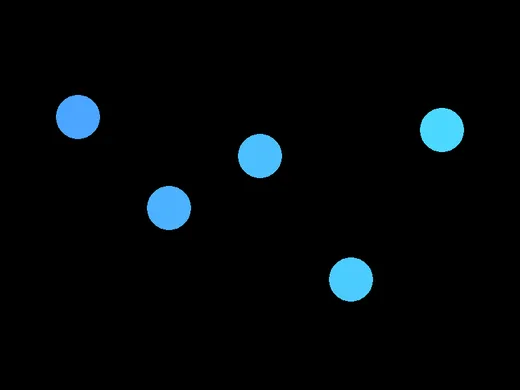
Five circles in five places, from two tables and one loop.
You Have Both Halves Already
print(crew[1])print(crew[2])print(crew[3])You Have Both Halves Already
print(crew[1])print(crew[2])print(crew[3])A table holds many values. A loop counts. The index is the count.
Which Is One Line
for i = 1, #crew do print(crew[i])endWhich Is One Line
for i = 1, #crew do print(crew[i])end#crew from last session is the end of the count, so the loop fits the table however long it is.
Add a fourth name and nothing else changes.
Traversal
Visiting every element of a list, in order. The exam's word, and it appears constantly.
Almost everything anyone does with a list is a traversal with one line changed in the middle.
Lua Has a Shorter Way
for i, name in ipairs(crew) do print(i, name)endLua Has a Shorter Way
for i, name in ipairs(crew) do print(i, name)end1 Ada2 Bo3 CyTwo Names, Not One
for i, name in ipairs(crew) do- i
- Which one you are on. 1, then 2, then 3.
- name
- The value itself. You do not have to look it up.
Same idea as the mouse giving you two answers at session 13.
Which One Should You Use?
- for i = 1, #t
- When you need the index for something else — a second table, a position, a count.
- ipairs
- When you only want the values.
ipairs gives you both, so it is rarely wrong. The indexed one is what the exam looks like.
Two Tables, One Index
local xs = {120, 260, 400, 540, 680}local ys = {180, 320, 240, 430, 200}xs[3] and ys[3] are the same circle. The index is what connects them.
Parallel lists. Nothing in the code says they belong together — you have to keep them the same length yourself.
Today's Objectives
- Traverse a table with an indexed loop
- Traverse a table with
ipairs - Use one index across two tables
- Draw N shapes from N stored values
Key Terms
- Traversal
- Visiting every element of a list, in order.
- ipairs
- A loop that hands you the index and the value together.
- Parallel lists
- Two lists where the same index means the same thing in both.
'F' → Fullscreen
Build
Task 1: Both Ways
Copy template-console to 1-20-walk. Make a table of five things — anything — and print it twice, once each way:
local crew = {"Ada", "Bo", "Cy", "Dee", "Eli"}
for i = 1, #crew do print(i .. ": " .. crew[i])end
print("---")
for i, name in ipairs(crew) do print(i .. ": " .. name)endThe output is identical. Then add a sixth name and run it again without touching either loop.
Task 2: Do Something to Each One
Make a table of five numbers. In one traversal, print each number doubled. In another, add them all up and print the total:
local scores = {12, 8, 21, 3, 17}local total = 0
for i, score in ipairs(scores) do total = total + scoreend
print("Total: " .. total)print("Count: " .. #scores)print("Average: " .. total / #scores)local total = 0 goes above the loop, not inside it. This is the same rule as session 15's tries and session 14's hits. Third time; it should be a habit by now.Task 3: Five Circles From Two Tables
Copy template-game to 1-20-sprites:
local xs = {120, 260, 400, 540, 680}local ys = {180, 320, 240, 430, 200}
function love.draw() for i, x in ipairs(xs) do love.graphics.setColor(0.3, 0.6 + i / 20, 1) love.graphics.circle("fill", x, ys[i], 34) endendThen add a sixth position to both tables and run it. A sixth circle appears and you changed no code.
Task 4: Break the Pair on Purpose
Add a value to xs and not to ys. Run it.
The window turns blue. Copy the message and work out which table the loop was walking, and which one ran out.
Then do the opposite — add to ys and not xs. This one does not crash, and that is worse. Write down what you see and why.
Task 5: Make Them Yours
Add a third parallel table and use it for something — radius, color, or both. Then pick one:
- Make one circle in the list move, using its index to pick which
- Draw a line from each circle to the next one
- Use the index to number the circles on screen
Challenge (Optional): The Hole
Back in the terminal:
local gappy = {"a", nil, "c"}
for i, v in ipairs(gappy) do print(i, v)end
print("#gappy is " .. #gappy)1 a#gappy is 1The "c" is in the table and the traversal never reached it. So did #gappy.
This is last session's warning with a loop attached: a table with a gap in it is not a list, and every tool that walks a list stops at the hole. Write down what this means for a table you build by deleting things out of the middle.
Same Idea, Exam Notation
The exam traverses lists constantly, and it does it with the loop that has no counter — so a counter gets built by hand.
local crew = {"Ada", "Bo", "Cy"}
for i = 1, #crew do print(crew[i])endcrew ← ["Ada", "Bo", "Cy"]i ← 1
REPEAT LENGTH(crew) TIMES{ DISPLAY(crew[i]) i ← i + 1}| Lua | Exam notation | |
|---|---|---|
| How many elements | #crew | LENGTH(crew) |
| The first one | crew[1] | crew[1] |
| Walk the whole list | for i = 1, #crew do | REPEAT LENGTH(crew) TIMES |
ipairs on the exam. It is a Lua convenience, and a good one. Use it in your own programs and expect the indexed form on the exam.The index still starts at 1 in both, which is the agreement from session 18 doing real work. A traversal written in Lua and the same traversal in exam notation visit the same elements in the same order.
Checkpoint
1-20-walkprints the same list two different ways- Adding a sixth item changed no loop
1-20-spritesdraws its circles from two parallel tables- Both mismatch experiments from task 4 are written down
- A third parallel table is doing something
Reflection
Answer the following questions before submitting your work.
- You added a sixth circle by adding two numbers and changing no code. Explain what makes that possible, and describe what you would have had to do in session 2 to add a sixth shape.
- A longer
xscrashed and a longerysdid not. Explain the difference, and say which of the two you would rather have happen in a program you were about to hand in. - Nothing in the code says
xsandysbelong together. Explain what actually connects them, and describe one way that could go wrong that Lua would never warn you about.
Submit
Submit the required files to the appropriate dropbox.