Session 2: Materials for the Router

Session 2
Materials for the Router
Ms. Delgado's Bench Split
It was wood, skateboards wrecked it, and the plows bury the sidewalk every winter. The material was in her requirements before anyone said the word.
Your arcade client will do the same: a steamy room, a greasy kitchen, a cabinet dragged across the floor every week.
Three Sheets, Three Insides
Plywood: thin layers of wood, called plies, glued with their grain crossing.
MDF (medium-density fiberboard): wood fiber and glue, pressed into a flat sheet with no grain at all.
Three Sheets, Three Insides
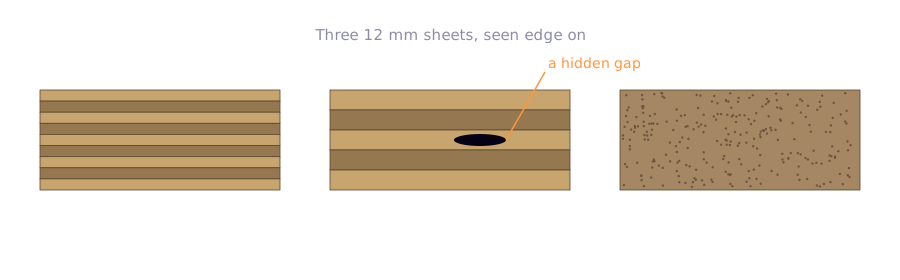
Everything you'll test today comes back to what's inside.
A Screw Grips What It Bites Into
In plywood, the threads bite into wood fibers. In MDF they bite into pressed dust and glue.
MDF holds a screw in its face, once. Back it out and drive it again, especially in the edge, and the threads can just spin.
An arcade cabinet gets opened for repairs. Some of its screws come out every month.
Water Finds the Edge
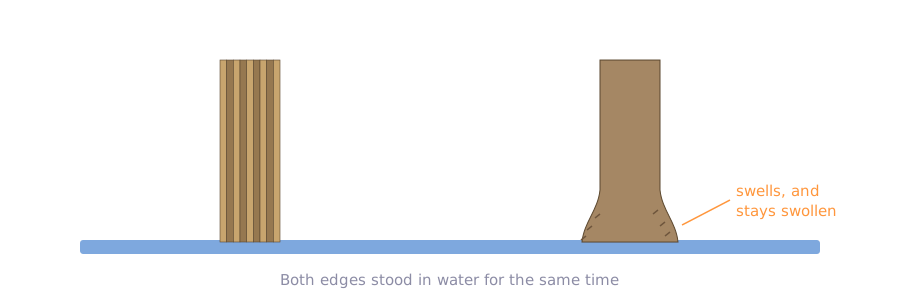
MDF's cut edge drinks water and swells, and it doesn't shrink back. A cabinet in a damp room, or on a floor that gets mopped, starts failing from the bottom edge.
MDF Paints Beautifully
Its face is smooth and grainless, so paint goes on flat. Its cut edge soaks paint up, so it needs sealing first.
Plywood shows its grain and its plies at every edge: good if you want the wood to show, bad if you want a flat painted finish.
Heavier Adds Up
MDF is the heaviest of the three. One panel won't matter. Six panels in a cabinet someone has to carry through a doorway will.
The Property Comparison
| Baltic Birch | Standard Plywood | MDF | |
|---|---|---|---|
| Edge quality when routed | Excellent | Fair | Excellent |
| Screw-holding | Good | Good | Poor (edge), fine (face, once) |
| Moisture | Fair: swells a little | Fair: plies can separate if soaked | Poor: edges swell and stay swollen |
| Paint finish | Good, grain shows | Fair, grain and gaps show | Excellent face; edges need sealing |
| Weight | Moderate | Moderate | Heavy |
| Cost | Highest | Middle | Lowest |
Today you test four of these rows yourself.
A Cabinet Isn't One Material
A side panel, a control panel, and a back access panel do different jobs. There's no reason they should be the same material.
Name the property the part needs. Cost is a property too, but it's rarely the one that decides.
Start the Water First
It's the slowest test. Get it soaking, then screws, then paint and weight, then read the water.
Next Time
Session 3: 3D Printing
The parts a sheet can't make.
'F' → Fullscreen
Build
Each group gets one sample of each material, all the same size and thickness. Safety glasses on for the drill. Your Unit 1 certification covers the drill and impact driver.
Step 1: Start the Water Test
- With calipers, measure each sample's thickness 10 mm from one end. Mark the spot in pencil.
- Stand that end of each sample in the water tray, about 1 cm deep, and write down the time.
Step 2: The Screw Test
Use the dry end of each sample.
- Drill a pilot hole into the face and another into the middle of the edge. Same bit, same depth, every hole.
- Drive a screw into each hole until it's snug.
- Back each screw out and drive it again, three times. After each time, record whether it still tightens, feels weaker, or spins.
Step 3: Paint and Weight
- Draw one stripe with the paint marker across the face and onto the cut edge of each sample. Compare how the face and the edge take it.
- Weigh each sample.
Step 4: Read the Water Test
Take the samples out, pat them dry, and measure the same marked spot. Record the change in thickness, then run a finger along each wet edge and describe what you feel.
Step 5: Choose for Three Components
Choose Baltic birch, standard plywood, or MDF for each part, and justify it with at least two properties, using today's results where you can.
- Side panel: structural, holds the cabinet's shape and any leg levelers or casters
- Control panel: where joysticks and buttons mount, takes repeated impact
- Back access panel: removed and reattached whenever the electronics need repairs
Then the twist: the cabinet moves to a school cafeteria where the floor is mopped every afternoon. Which of your choices changes, and why?
Checkpoint
- Did every choice name two properties?
- "It's cheaper" alone doesn't justify any of the three.
- Did you use what you measured?
- A choice that cites your own screw or water result is stronger than one that cites the table.
- Did the cafeteria change anything?
- If nothing changed, say which property makes your original choice survive a wet floor.
Reflection
Answer these on your own. Reflections are individual, even when the rest of the session was team work.
- A classmate picks MDF for a bracket with a bolt threaded into its edge, saying “MDF is the cheapest and its routed edge quality is excellent.” Both of those facts are true. Why is the choice still wrong?
- Which of today's test results surprised you most, and which cabinet part does it affect?
- Session 3 covers 3D printing. Is there any part of an arcade cabinet you'd print instead of routing from sheet stock? Why?
Submit
Submit your sheet: all four test results, your three material choices with the cafeteria twist, and your reflection.