Back
simon.ino
Bonus Project: Simon
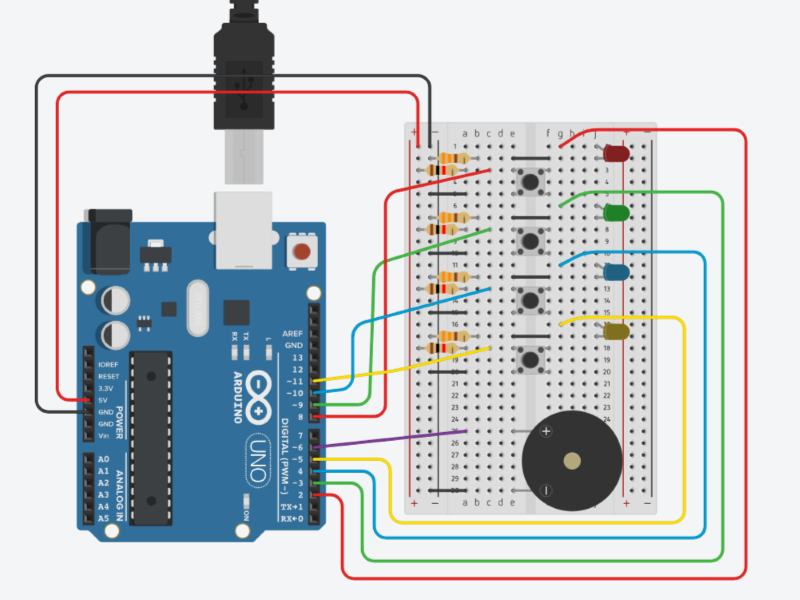
Task 1: Circuit
Note: A large breadboard and flat jumper wires are recommended for this project. The circuit diagram was created using a standard breadboard graphic, causing the components to appear more tightly packed than is ideal. When building the circuit, allow additional space between components to improve organization and troubleshooting.
Required components:- (4) LEDs
- (4) 330 ohm resistors
- (4) push buttons
- (4) 10k ohm resistors
- (1) buzzer
Task 2: Code
// Pin Definitionsconst int ledPins[] = {2, 3, 4, 5}; // Red, Green, Blue, Yellowconst int buttonPins[] = {8, 9, 10, 11}; // Red, Green, Blue, Yellowconst int buzzerPin = 6;
// Audio Frequencies for each button (Red, Green, Blue, Yellow)const int tones[] = {262, 330, 392, 523}; // C4, E4, G4, C5const int loseTone = 120; // Sad, low buzz for game over
// Game Variables#define MAX_SEQUENCE 100int sequence[MAX_SEQUENCE];int gameRound = 0;
void setup(){ // Initialize LEDs and Buttons for (int i = 0; i < 4; i++) { pinMode(ledPins[i], OUTPUT); pinMode(buttonPins[i], INPUT); // External pull-up, so standard INPUT digitalWrite(ledPins[i], LOW); } pinMode(buzzerPin, OUTPUT);
// Seed random generator using noise from unconnected analog pin randomSeed(analogRead(A0));
delay(1000); // Brief pause before game starts automatically}
void loop(){ // 1. Add a new random step to the sequence (0 to 3) sequence[gameRound] = random(0, 4); gameRound++;
// 2. Play the current sequence to the player playSequence();
// 3. Get and check player inputs if (!getPlayerInput()) { gameOver(); // Reset game state gameRound = 0; delay(1500); return; }
delay(600); // Pause before next round starts}
// Function to play the stored sequencevoid playSequence(){ for (int i = 0; i < gameRound; i++) { int currentStep = sequence[i];
digitalWrite(ledPins[currentStep], HIGH); tone(buzzerPin, tones[currentStep], 300); delay(300); digitalWrite(ledPins[currentStep], LOW); delay(1500 / (gameRound + 2)); // Dynamic pacing gets slightly faster }}
// Function to capture and validate user inputbool getPlayerInput(){ for (int i = 0; i < gameRound; i++) { int expectedButton = sequence[i]; int pressedButton = -1;
// Wait until a button is pressed while (pressedButton == -1) { for (int b = 0; b < 4; b++) { // Active LOW due to external pull-ups if (digitalRead(buttonPins[b]) == LOW) { pressedButton = b;
// Provide instant feedback for the press digitalWrite(ledPins[b], HIGH); tone(buzzerPin, tones[b]);
// Debounce and wait for release delay(50); while (digitalRead(buttonPins[b]) == LOW); delay(50);
noTone(buzzerPin); digitalWrite(ledPins[b], LOW); break; } } }
// Check if the pressed button matches the sequence if (pressedButton != expectedButton) { return false; // Wrong button pressed } } return true; // Whole round cleared successfully}
// Game Over Animation and Soundvoid gameOver(){ // Low pitch buzz to signify failure tone(buzzerPin, loseTone, 800);
// Blink all four LEDs 3 times for (int i = 0; i < 3; i++) { for (int l = 0; l < 4; l++) { digitalWrite(ledPins[l], HIGH); } delay(250); for (int l = 0; l < 4; l++) { digitalWrite(ledPins[l], LOW); } delay(250); } noTone(buzzerPin);}